Types of Artificial Intelligence: A Complete Beginner’s Guide
Published: 2 Nov 2026
Artificial Intelligence (AI) is becoming an important part of our daily lives. It helps people find information, create content, understand languages, recognize images, and solve different problems. However, AI is not just one technology. It includes several types, methods, and systems that work in different ways.
In this beginner’s guide, you will learn about the main types of Artificial Intelligence, how they are classified, the technologies used to build AI systems, and real-world examples of how AI is used.
1. What Is Artificial Intelligence?
Artificial Intelligence is a field of computer science that focuses on creating systems that can perform tasks usually associated with human intelligence. These tasks may include learning from data, recognizing patterns, understanding language, solving problems, and generating content.
For example, a navigation app can suggest a route, an AI chatbot can answer questions, and an image recognition system can identify objects in a photograph.
AI systems do not all work in the same way. Some follow predefined rules, while others learn patterns from data. Their abilities depend on how they are designed, trained, and used.
2. How Does Artificial Intelligence Work?
AI systems use different methods to process information and produce results. The exact process depends on the type of system, but many modern AI applications follow these basic steps.
Collect Data:An AI system may use text, images, audio, numbers, or other information. The type and quality of data depend on the task.
Process the Information:The system organizes or analyzes the available information. Some systems use predefined rules, while others use statistical methods or trained models.
Learn Patterns or Apply Rules:A machine learning system learns patterns from training data. A rule-based system, in comparison, follows instructions created by developers.
Produce a Result:The system generates an output, such as a prediction, recommendation, classification, answer, or image.
Evaluate and Improve:Developers can evaluate the results and update the system when necessary. Not every AI system learns continuously from its users; some only change when they are retrained or updated.
For example, an email spam filter may analyze message patterns and classify an email as spam or legitimate. Its purpose is different from a generative AI tool that creates a new paragraph from a prompt.
3. Main Types of AI Based on Capabilities
One way to classify AI is by considering how broad its abilities are. This classification commonly includes Artificial Narrow Intelligence, Artificial General Intelligence, and Artificial Superintelligence.
Artificial Narrow Intelligence (ANI)
Artificial Narrow Intelligence, also called Narrow AI or Weak AI, is designed to perform specific tasks or a limited range of related tasks.It can perform its intended job effectively, but it does not have general human-like intelligence across every field.
Examples include:
- Voice assistants that respond to commands
- Recommendation systems that suggest videos or products
- Email filters that detect spam
- AI tools that generate text or images
Main characteristic: Narrow AI works within the capabilities and limitations of its design.
Most AI applications available today are examples of narrow AI, even when they can perform several related tasks.
Artificial General Intelligence (AGI)
Artificial General Intelligence refers to a hypothetical form of AI that could learn, understand, and perform a broad range of intellectual tasks at a level comparable to humans.
Unlike narrow AI, AGI would be expected to transfer knowledge between different tasks and handle unfamiliar problems more generally.
Possible characteristics include:
- Learning across different subject areas
- Applying knowledge to new situations
- Solving a wide range of unfamiliar problems
- Adapting to different intellectual tasks
AGI has not been conclusively achieved. Current AI systems can perform many impressive tasks, but this does not by itself establish that they possess general human-level intelligence.
Artificial Superintelligence (ASI)
Artificial Superintelligence refers to a hypothetical AI that would surpass human intellectual abilities across a broad range of areas.
It is a theoretical concept discussed in AI research, philosophy, and future technology debates. It is not an established real-world AI category with existing examples.
Possible capabilities discussed in theory include advanced scientific reasoning, complex problem-solving, and the ability to develop ideas beyond current human capabilities.
Main characteristic: ASI is a hypothetical future concept, not a currently available technology.
ANI vs. AGI vs. ASI
| Type | Meaning | Current Status |
|---|---|---|
| ANI | Performs specific tasks | Widely used today |
| AGI | General intelligence across many tasks | Not conclusively achieved |
| ASI | Intelligence beyond humans across broad areas | Hypothetical |
These three categories describe the potential scope of AI capabilities. They do not describe individual technologies such as machine learning or computer vision.
Types of AI Based on Functionality
Another commonly used classification describes AI according to how a system responds to information, uses past data, or represents other people’s mental states.
This is a different classification from ANI, AGI, and ASI. It is a simplified conceptual framework, and the categories should not be confused with the technologies used to build AI.
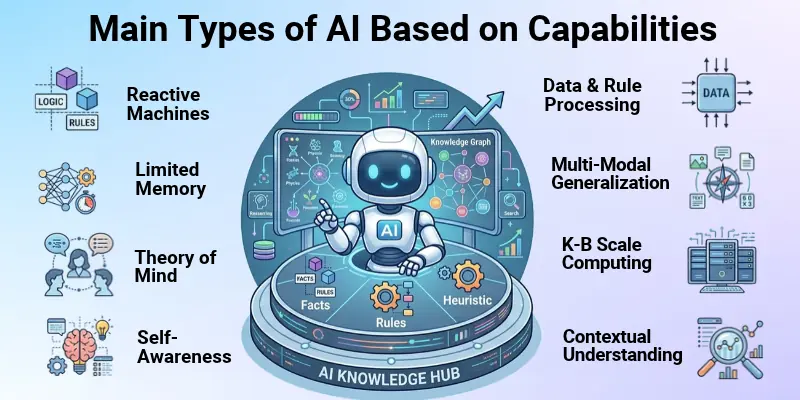
Reactive Machines
Reactive machines respond to the current input without using a stored history of past experiences to guide their decisions.
They can evaluate a situation and choose a response, but they do not build a memory of previous interactions in the way a limited-memory system does.
Example: IBM’s Deep Blue chess computer is a classic example of a reactive system. It analyzed chess positions and selected moves without learning from a personal history of previous games during play.
Key point: Reactive machines respond to the current situation rather than relying on remembered past experiences.
Limited-Memory AI
Limited-memory AI uses information from previous observations or stored data to make decisions or produce results.
Many modern AI systems use historical data during training. Some also use recent observations or conversation context when responding.
Examples include:
- Driver-assistance systems that use recent sensor information
- Systems that predict demand using historical records
- AI applications that use conversation context to respond to follow-up questions
Not every modern AI system has the same kind of memory. A model trained on historical data may not automatically remember individual users or learn from each new interaction.
Key point: Past information can help a system make better decisions, but its memory and learning abilities depend on its design.
Theory-of-Mind AI
Theory-of-mind AI refers to a proposed form of AI that could understand or represent people’s beliefs, intentions, emotions, and perspectives in a more complete way.
Such capabilities could potentially help AI systems interact more appropriately with people. However, recognizing emotional patterns or predicting someone’s response is not the same as fully understanding human mental states.
Status: This remains an area of research and a conceptual category, rather than a fully achieved type of AI.
Self-Aware AI
Self-aware AI refers to a hypothetical system that would possess genuine self-awareness or conscious awareness of its own existence.
There is no established evidence that today’s AI systems have achieved this kind of consciousness. An AI system can describe itself, discuss emotions, or produce human-like language without proving that it has subjective experiences.
Status: Self-aware AI remains hypothetical.
Quick Comparison
| Type | Main Idea | Status |
|---|---|---|
| Reactive machines | Respond to current input | Existing concept with real examples |
| Limited-memory AI | Uses stored or recent information | Common in modern applications |
| Theory-of-mind AI | Would model mental states more fully | Research concept |
| Self-aware AI | Would possess genuine self-awareness | Hypothetical |
Important AI Technologies and Approaches
The categories above describe AI by capability or functionality. The following section covers technologies and approaches used to create AI applications.
These technologies are not all separate or mutually exclusive. A single application may combine several of them.
5.1 Machine Learning (ML)
Machine learning is a branch of AI that enables computer systems to learn patterns from data and use those patterns to make predictions or decisions.
Instead of requiring developers to write a separate rule for every possible situation, machine learning algorithms identify useful relationships in training data.
Common uses include:
- Predicting sales or demand
- Detecting unusual transactions
- Recommending products
- Classifying emails
- Estimating future trends
For example, a business may use machine learning to estimate which products are likely to sell more during a particular season.
Deep Learning
Deep learning is a specialized part of machine learning that uses artificial neural networks with multiple layers to learn complex patterns.
It is particularly useful for tasks involving large amounts of text, images, audio, or other complex data.
Common uses include:
- Image and object recognition
- Speech recognition
- Language processing
- Generating text and images
- Analyzing complex patterns
Deep learning often requires substantial computing resources and suitable training data, although requirements vary depending on the task and model.
Natural Language Processing (NLP)
Natural Language Processing is a field of AI concerned with enabling computers to process and work with human language.
NLP can involve understanding, analyzing, classifying, or generating language. It includes methods ranging from traditional linguistic techniques to modern deep learning models.
Common uses include:
- Text classification
- Language translation
- Sentiment analysis
- Information extraction
- Chatbots and language-based assistants
For example, a customer support system may analyze a message to identify whether a customer is asking about a refund, delivery, or product issue.
Computer Vision
Computer vision enables computers to analyze and interpret visual information, such as photographs and video.
Depending on the task, a computer vision system may identify objects, classify images, locate items, or detect changes in a scene.
Common uses include:
- Detecting objects in images
- Analyzing medical images
- Identifying defects in manufactured products
- Reading text from scanned documents
- Supporting driver-assistance systems
For example, a quality-control system in a factory may use computer vision to identify visible defects in products.
Generative AI
Generative AI refers to AI systems that create new content based on patterns learned from data. Depending on the model, the output may be text, images, audio, video, or computer code.
Users often interact with generative AI by providing a prompt that describes what they want.
Common uses include:
- Drafting and editing text
- Generating images
- Creating outlines and summaries
- Assisting with programming
- Producing audio or video content
Generative AI can be useful for creative and productivity tasks, but its outputs may contain errors, invented information, or unsuitable material. Important results should be reviewed before use.
Speech Processing and Speech Recognition
Speech-related AI works with spoken language and audio signals. Speech recognition focuses on converting spoken words into text, while other speech technologies can identify speakers, analyze audio, or generate spoken output.
Common uses include:
- Voice typing
- Automatic transcription
- Voice-controlled applications
- Speech-to-text tools
- Text-to-speech systems
For example, a transcription tool can convert a recorded meeting into written text. The accuracy may vary with accents, background noise, recording quality, and the language being spoken.
Speech processing and NLP can work together, but they solve different parts of a task: one may process audio, while the other analyzes the language.
Robotics
Robotics combines engineering, sensors, control systems, and software to create machines that perform physical tasks. Some robots use AI to interpret their surroundings or make decisions.
Common uses include:
- Manufacturing and assembly
- Warehouse operations
- Agricultural tasks
- Medical assistance
- Exploration in difficult environments
Not every robot uses AI. Many robots follow programmed instructions, while AI-enabled robots may use computer vision, planning, or machine learning to respond to changing conditions.
Expert Systems
Expert systems are computer programs designed to solve specific problems using stored knowledge and rules. Traditional expert systems often use if-then rules to reach conclusions in a defined subject area.
Common uses include:
- Technical troubleshooting
- Rule-based decision support
- Diagnosing equipment faults
- Checking compliance with defined requirements
For example, a troubleshooting system may suggest possible causes of a machine problem based on the answers a user provides.
Traditional expert systems differ from machine learning systems because their decision rules are generally created by people rather than learned directly from large datasets. Modern applications may combine rule-based methods with machine learning.
AI vs. Machine Learning vs. Deep Learning
Artificial Intelligence, machine learning, and deep learning are related terms, but they do not mean the same thing.
- Artificial Intelligence: The broad field of building systems that perform tasks associated with intelligence.
- Machine Learning: A branch of AI that learns patterns from data.
- Deep Learning: A specialized branch of machine learning that uses multilayer neural networks.
The relationship can be shown as follows:
Artificial Intelligence → Machine Learning → Deep Learning
Deep learning is part of machine learning, and machine learning is part of the broader field of AI. However, not all AI systems use machine learning, and not all machine learning systems use deep learning.
| Feature | Artificial Intelligence | Machine Learning | Deep Learning |
|---|---|---|---|
| Scope | Broad field | Part of AI | Part of ML |
| Main approach | May use rules, search, learning, or other methods | Learns patterns from data | Learns complex patterns using multilayer neural networks |
| Data needs | Depends on the method | Usually needs suitable training data | Often benefits from large datasets, depending on the task |
| Example | A rule-based expert system | A model predicting sales | A neural network recognizing objects in images |
Understanding this relationship makes it easier to learn AI without confusing the overall field with one particular technique.
Real-World Applications of AI
AI is used across many industries. The application depends on the problem being solved, the data available, and the technology selected.
| Industry | Example Application | Potential Benefit |
|---|---|---|
| Education | Personalized practice and learning support | Helps learners review topics and receive feedback |
| Healthcare | Medical-image analysis and administrative support | Assists professionals with specific tasks |
| E-commerce | Product recommendations and demand forecasting | Helps businesses understand customer needs |
| Digital marketing | Content assistance and campaign analysis | Supports planning and performance analysis |
| Finance | Fraud detection and risk analysis | Helps identify unusual patterns |
| Manufacturing | Visual quality inspection | Helps detect product defects |
| Transportation | Route planning and driver-assistance systems | Supports navigation and safety-related tasks |
| Customer service | Chatbots and message classification | Handles some routine questions |
AI does not guarantee better results in every situation. Its effectiveness depends on the quality of the system, the available information, how it is used, and whether people check its results when needed.
Advantages and Limitations of AI
AI offers useful capabilities, but it also has limitations. Understanding both sides helps people decide when and how to use it.
Advantages of AI
- Automation: AI can handle some repetitive tasks, saving time.
- Data analysis: It can identify patterns in large datasets.
- Consistency: A properly designed system can apply the same process repeatedly.
- Productivity support: AI tools can help with drafting, summarizing, planning, and research.
- Accessibility: Speech, translation, and assistive tools can help people access information in different ways.
Limitations of AI
- Incorrect results: AI systems can produce errors or misleading information.
- Bias: Problems in training data or system design can lead to unfair results.
- Privacy concerns: Sensitive information must be handled carefully.
- Cost and resources: Developing and operating some systems can require significant computing power and expertise.
- Limited understanding: Human-like responses do not necessarily mean an AI system understands a topic as a person does.
- Human oversight: Important decisions may require professional judgment and verification.
AI should be treated as a tool that supports human work, not as a guarantee of accuracy or a replacement for judgment in every situation.
How to Start Learning AI
You do not need to learn every AI technology at once. The best starting point depends on your goals, current skills, and the type of work you want to do.
Path 1: AI Tools for Beginners
This path is suitable for people who want to use AI tools for everyday tasks, study, content creation, or digital marketing.
Start with:
- Learn basic AI concepts and common terms.
- Practice writing clear prompts.
- Use AI to create outlines, summarize information, and brainstorm ideas.
- Verify important facts instead of accepting every output.
- Learn about privacy, copyright, and responsible use.
Path 2: AI for Digital Marketing and Content Creation
This path is useful for bloggers, content creators, and digital marketers who want to use AI as part of their workflow.
Start with:
- Learn the basics of SEO and content writing.
- Use AI to brainstorm article ideas and create outlines.
- Research keywords and understand search intent.
- Edit AI-assisted content for accuracy, originality, and reader value.
- Review content performance and improve it based on reliable data.
AI can support content work, but useful content still requires research, editing, and a clear understanding of the audience.
Path 3: Machine Learning and Data Science
This path is suitable for learners who want to understand how AI models are built.
Start with:
- Learn basic mathematics and statistics.
- Learn Python programming.
- Understand data collection and data cleaning.
- Study basic machine learning concepts.
- Build small projects using suitable datasets.
Path 4: Generative AI Development
This path is for people interested in building applications that use generative AI models.
Start with:
- Learn basic programming.
- Understand how language and generative models work at a high level.
- Learn about prompts, model limitations, and evaluation.
- Practice using model APIs or beginner-friendly development tools.
- Build a small application and test its outputs carefully.
Path 5: Robotics and Computer Vision
This path is suitable for learners interested in visual recognition, physical machines, or automation.
Start with:
- Learn basic programming.
- Study relevant mathematics and logical problem-solving.
- Learn computer vision or robotics fundamentals.
- Practice with small image-analysis or simulation projects.
- Explore sensors, hardware, and control systems when relevant.
Beginner tip: Choose one path first. Build a basic understanding and complete small practical projects before trying to learn every AI topic.
10. The Future of Artificial Intelligence
AI is continuing to develop, with research and applications expanding across language, images, scientific work, robotics, and business processes.
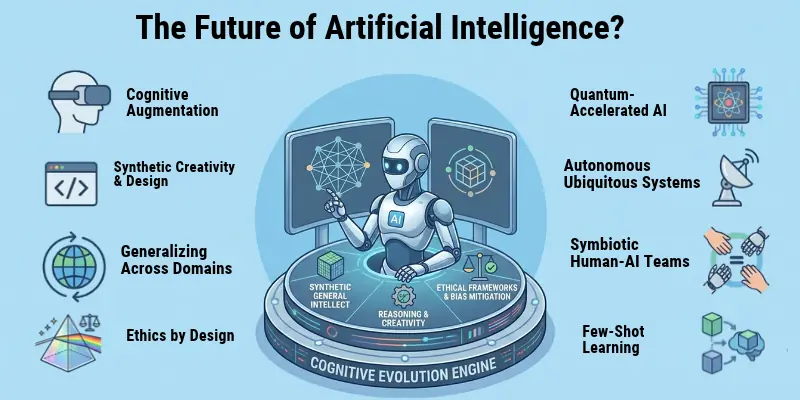
Some important areas to watch include:
More Capable AI Assistants
AI assistants may become better at helping users complete connected tasks, organize information, and work with different tools. Their reliability will still depend on the system and the task.
Multimodal AI
Multimodal systems can work with more than one type of information, such as text, images, audio, and video. This can support applications that need to combine different forms of input.
AI in Science and Healthcare
Researchers are exploring ways to use AI for scientific analysis, medical research, and decision support. These applications require careful testing, appropriate safeguards, and expert oversight.
Responsible AI Development
Privacy, fairness, transparency, safety, and accountability are important issues as AI becomes more widely used. Organizations need to consider how their systems affect people and how mistakes can be identified and corrected.
Human-AI Collaboration
In many fields, AI may support people by handling specific tasks, generating ideas, or analyzing information. Human skills such as critical thinking, communication, creativity, and professional judgment will remain important.
The future of AI is not fully predictable. Its impact will depend on technological progress, regulation, responsible development, and the ways people choose to use it.
11. Key Takeaways
Here are the most important points to remember:
- AI is a broad field that includes different methods and applications.
- ANI, AGI, and ASI classify AI according to the scope of its capabilities.
- Reactive machines, limited-memory AI, theory-of-mind AI, and self-aware AI are categories in a commonly used functionality-based framework.
- Machine learning and deep learning are related fields within AI.
- NLP, computer vision, speech processing, robotics, and generative AI address different tasks and may be combined in one application.
- AI can improve productivity, but its results need to be evaluated carefully.
- Beginners should choose a learning path based on their goals and practice with small projects.
12. Frequently Asked Questions
1. What are the main types of Artificial Intelligence?
AI is commonly classified by capabilities into ANI, AGI, and ASI. Another conceptual framework includes reactive machines, limited-memory AI, theory-of-mind AI, and self-aware AI. These classifications describe different aspects of AI.
2. How many types of AI are there?
There is no single universal number. The number depends on the classification framework being used. Some frameworks describe three capability-based categories, while another commonly used framework describes four functionality-based categories.
3. What is the most common type of AI today?
Most AI applications in use today fall under Artificial Narrow Intelligence (ANI) because they are designed for specific tasks or limited groups of tasks.
4. Is Artificial General Intelligence available today?
AGI has not been conclusively achieved. Current AI systems can perform many different tasks, but broad performance alone does not prove that a system has general human-level intelligence.
5. What is Artificial Superintelligence?
Artificial Superintelligence is a hypothetical form of AI that would surpass human intellectual abilities across a broad range of areas. It is not an established current technology.
6. What is the difference between ANI and AGI?
ANI focuses on specific tasks, while AGI would be able to learn and perform a broad range of intellectual tasks more generally. ANI is widely used today; AGI remains unconfirmed.
7. What is machine learning in simple words?
Machine learning is a branch of AI that allows computer systems to learn patterns from data and use those patterns to make predictions or decisions.
8. Is machine learning the same as AI?
No. AI is the broader field, and machine learning is one part of it. Some AI systems use predefined rules or other methods instead of learning from data.
9. What is deep learning used for?
Deep learning is used for tasks such as image recognition, speech recognition, language processing, and generating content. It uses neural networks with multiple layers to learn complex patterns.
10. What is the difference between machine learning and deep learning?
Machine learning includes many methods for learning from data. Deep learning is a specialized type of machine learning that uses multilayer neural networks.
11. What is Natural Language Processing?
Natural Language Processing, or NLP, is a field of AI that helps computers process, analyze, and work with human language. Examples include translation, text classification, and language-based assistants.
12. What is computer vision in AI?
Computer vision enables computers to analyze images and video. It can be used for object detection, visual inspection, document analysis, and other image-related tasks.
13. What is generative AI?
Generative AI creates new content, such as text, images, audio, video, or code, based on patterns learned during training. Its results should be checked for accuracy and suitability.
14. Is every robot an AI robot?
No. Some robots follow fixed instructions and do not use AI. AI-enabled robots may use techniques such as computer vision or machine learning to respond to their surroundings.
15. Can AI make mistakes?
Yes. AI systems can generate incorrect information, miss important context, or produce biased results. Important outputs should be verified, especially when they affect health, finances, safety, or other significant decisions.
16. Which AI field should a beginner learn first?
It depends on the goal. People interested in content creation can begin with AI tools and prompt writing. Those who want to build AI systems can start with programming, mathematics, and basic machine learning.
17. Do I need to learn coding to use AI?
No. Many AI tools can be used without coding. However, programming is important for people who want to develop AI applications, train models, or work in technical AI roles.
18. Can AI help with digital marketing?
Yes. AI can assist with brainstorming, content outlines, keyword research workflows, customer analysis, and campaign reporting. Human review is still important for accuracy, originality, and strategic decisions.
19. Will AI replace human jobs?
AI may automate some tasks and change the skills required for certain jobs. Its effects will vary by industry and role. Learning relevant digital skills and adapting to new tools can help people prepare for changes in the workplace.
20. How can I use AI responsibly?
Avoid sharing sensitive personal information unnecessarily, verify important outputs, check for bias, respect privacy and copyright, and use human judgment for high-impact decisions.
Conclusion
Artificial Intelligence includes many types, technologies, and approaches. Understanding the difference between capability-based classifications, functionality-based categories, and practical AI technologies makes the subject easier to learn.
From machine learning and computer vision to generative AI and robotics, each area solves different problems and has its own strengths and limitations. Some AI concepts, such as AGI and self-aware AI, remain hypothetical, while narrow AI applications are already widely used.
If you are new to AI, start with the concepts that match your goals, practice with suitable tools, and build your knowledge step by step. A clear understanding of both the benefits and limitations of AI will help you use it more effectively and responsibly.


- Be Respectful
- Stay Relevant
- Stay Positive
- True Feedback
- Encourage Discussion
- Avoid Spamming
- No Fake News
- Don't Copy-Paste
- No Personal Attacks
- Be Respectful
- Stay Relevant
- Stay Positive
- True Feedback
- Encourage Discussion
- Avoid Spamming
- No Fake News
- Don't Copy-Paste
- No Personal Attacks
