A Beginner’s Guide to AI
Published: 29 Oct 2026
Have you ever wondered how AI tools answer questions, recognize images, or create content in seconds? Artificial Intelligence (AI) is becoming an important part of our daily lives, but how does it actually work? In this beginner-friendly guide, you will learn what AI means, how it works, its main types, advantages and disadvantages, and how it is used in everyday life.
We will also explore the difference between AI and human intelligence, the future of AI, and how beginners can start learning this exciting technology. By the end of this article, you will have a clearer understanding of AI and how to use it responsibly.
What Is Artificial Intelligence?
Artificial intelligence (AI) is a branch of computer science that focuses on creating computer systems capable of performing tasks that normally require human intelligence. These tasks may include understanding language, recognising images, learning patterns from data, solving problems, and making predictions.
In simple words, AI is technology that enables computers to perform tasks that appear intelligent.
But here is an important question: Does performing an intelligent task mean that a computer thinks exactly like a human? Not necessarily. AI systems use different computational methods, and their abilities depend on how they are designed and trained.
Simple Examples of Artificial Intelligence
- Chatbots: Answer questions and help users find information.
- Voice assistants: Recognize spoken commands and respond to requests.
- Recommendation systems: Suggest videos, products, or music.
- Image recognition: Identify objects or patterns in pictures.
- Translation tools: Translate text between languages.
- AI writing tools: Help users generate and improve written content.
What Does AI Stand For?
AI stands for Artificial Intelligence.
The word “artificial” means something created by humans rather than occurring naturally. “Intelligence” refers to abilities such as learning, reasoning, understanding, and solving problems.
Together, artificial intelligence describes computer technology designed to perform tasks associated with intelligent behaviour.
For example, a person can read a question and write an answer. An AI system can also process a question and generate a response, although its methods and abilities are different from those of a human.
AI is the short form commonly used in technology, education, business, and digital marketing.
History of Artificial Intelligence
The history of Artificial Intelligence (AI) began many years ago when scientists started exploring whether machines could think and solve problems like humans. In 1950, Alan Turing introduced important ideas about machine intelligence. In 1956, John McCarthy introduced the term “Artificial Intelligence” at a research meeting at Dartmouth College.
Over time, AI improved as computers became more powerful. In 1997, IBM’s Deep Blue defeated chess champion Garry Kasparov. Later, advances in machine learning helped AI recognize images, understand language, and solve complex problems. Today, AI tools such as chatbots and image generators are used in education, business, content creation, and everyday life.
How Does Artificial Intelligence Work?
Have you ever wondered how an AI tool can respond to a question it has never seen in exactly the same words before?
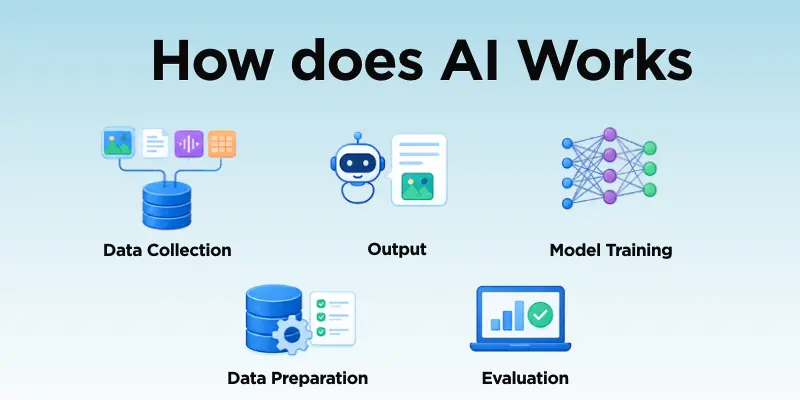
Many AI systems work by processing data and using patterns learned during training to produce an output. The exact process depends on the type of AI being used.
Step 1: Data Collection: An AI system may need data to learn patterns or perform a task. Data can include text, images, audio, numbers, or other information. For example, an image recognition system may use many labeled images to learn the difference between cats and dogs.
Step 2: Data Preparation: The data may need to be organized, checked, and prepared before it can be used. Poor-quality or inaccurate data can affect the system’s results.
Step 3: Model Training: During training, a machine learning model processes examples and adjusts its internal parameters to learn patterns in the data.
For example, a model trained on many examples of written language can learn patterns that help it generate text.
Step 4: Recognizing Patterns: After training, a model may use the patterns it has learned to make predictions, classify information, or generate content.
A spam detection system, for example, may identify patterns that suggest an email is unwanted.
Step 5: Producing an Output:
The AI system processes an input and produces a result.
- Input: A question written by a user.
- Processing: The AI system analyzes the text.
- Output: The system generates a response.
Step 6: Evaluation and Improvement:
Developers evaluate AI systems to understand how accurately and reliably they perform. They may improve the system by adjusting its design, training process, data, or instructions.
Remember, AI does not automatically become more accurate every time someone uses it. Some systems can adapt under specific conditions, while others require developers to update them.
Types of Artificial Intelligence
Narrow AI: Artificial intelligence can be categorized in different ways. One common approach describes AI according to its capabilities.
Narrow AI is designed to perform specific tasks or a limited range of tasks. Examples include spam filters, recommendation systems, voice recognition, and many current AI assistants.
Most AI systems available today fall into this category.
Artificial General Intelligence (AGI): Artificial general intelligence refers to a hypothetical form of AI that could learn and perform a broad range of intellectual tasks with general capabilities comparable to humans.
AGI has not been established as an achieved technology.
Artificial Superintelligence (ASI): Artificial superintelligence is a hypothetical concept describing AI that would exceed human intellectual capabilities across a wide range of areas.
It is a theoretical concept, not an established existing technology.
AI Types by Technique
AI can also be grouped by the methods it uses:
- Machine learning
- Deep learning
- Natural language processing
- Computer vision
- Generative AI
These categories describe different capabilities and technical approaches rather than separate levels of intelligence.
Advantages of Artificial Intelligence
Artificial intelligence offers several potential benefits when it is used appropriately.
- Automation of Repetitive Tasks: AI can automate some routine activities, allowing people to spend more time on tasks that require creativity, communication, or judgment.
- Faster Information Processing: AI systems can process certain types of information quickly and help users summarize or organize large amounts of data.
- Support for Learning: AI tools can explain difficult concepts, provide examples, and help learners practice at their own pace.
- Assistance With Content Creation: AI can help generate initial drafts, brainstorm ideas, organize outlines, and develop visual concepts.
- Pattern Recognition: AI can identify patterns in data and support tasks such as image classification, fraud detection, and forecasting.
- Availability of Digital Assistance: Some AI tools are available online at any time, making it possible for users to request help outside normal working hours.
The benefits vary by tool, and users should consider reliability, privacy, cost, and the need for human review.
Disadvantages and Limitations of AI
Although AI can be useful, it also has limitations that beginners should understand:
- Incorrect Information: AI tools can generate inaccurate answers or present uncertain information confidently. Important facts should be checked against reliable sources.
- Dependence on Data: Many AI systems rely on data for training or operation. Incomplete, outdated, or biased data can lead to poor results.
- Privacy Concerns: Sharing personal, confidential, or business-sensitive information with an AI tool can create privacy risks. Users should review the tool’s privacy practices and avoid entering sensitive information unnecessarily.
- Cost and Technical Requirements: Some AI services require paid subscriptions, specialized hardware, or technical knowledge. Costs can vary considerably between tools.
- Limited Human Judgement: AI may struggle with unusual situations, subtle context, complex social issues, or decisions that require accountability and careful human judgment.
- Potential Changes in Work: AI may automate some tasks and change the skills required for certain jobs. It can also create new opportunities and support workers in existing roles.
- Learning how to use AI responsibly can help people adapt to changes in technology.
Types of Artificial Intelligence
Artificial intelligence can be categorized in different ways. One common approach describes AI according to its capabilities.
Narrow AI: Narrow AI is designed to perform specific tasks or a limited range of tasks. Examples include spam filters, recommendation systems, voice recognition, and many current AI assistants.
Most AI systems available today fall into this category.
Artificial General Intelligence (AGI): Artificial general intelligence refers to a hypothetical form of AI that could learn and perform a broad range of intellectual tasks with general capabilities comparable to humans.
AGI has not been established as an achieved technology.
Artificial Superintelligence (ASI):Artificial superintelligence is a hypothetical concept describing AI that would exceed human intellectual capabilities across a wide range of areas.
It is a theoretical concept, not an established existing technology.
AI Types by Technique
AI can also be grouped by the methods it uses:
- Machine learning
- Deep learning
- Natural language processing
- Computer vision
- Generative AI
These categories describe different capabilities and technical approaches rather than separate levels of intelligence.
Examples of AI in Daily Life
You might use AI more often than you realize. But which everyday activities actually involve artificial intelligence?
Search Engines: Search engines use various technologies, including AI-based systems, to understand queries, rank results, and help users find relevant information.
Online Shopping: Shopping platforms may recommend products based on browsing activity, purchase history, product information, or similar users’ preferences.
Social Media: Social media platforms may use AI to recommend posts, identify spam, rank content, and detect certain forms of harmful activity.
Navigation Applications: Navigation services may use predictive models and other computational methods to estimate travel times, suggest routes, and analyze traffic conditions.
Email Services: Email services can use machine learning to detect spam, identify suspicious messages, and organize incoming mail.
Education: AI tools can explain concepts, help students practice, suggest writing improvements, and support personalized learning activities.
Digital Marketing and Content Creation: AI tools can help marketers brainstorm topics, organize keyword ideas, draft content, analyze information, and create visual concepts.
Human review remains important for accuracy, originality, and suitability for the intended audience.
Why Is Artificial Intelligence Important?
Why are so many industries exploring AI? One reason is that AI can help process information, automate certain tasks, and identify patterns in large amounts of data.
Saving Time: AI can assist with repetitive tasks, such as sorting information, summarizing documents, or drafting routine messages.
Processing Large Amounts of Data: Some AI systems can analyze large datasets and identify patterns that may be difficult to detect manually.
Supporting Decisions: AI can provide predictions, recommendations, or summaries that help people evaluate options. Important decisions should still involve appropriate human judgment.
Improving Accessibility: Speech recognition, captions, translation, and text-to-speech tools can help people access information in different ways.
Supporting Innovation: Researchers and businesses use AI to explore new approaches in scientific research, software development, education, and healthcare.
AI is valuable when it addresses a genuine need and provides reliable results.
What Problems Can AI Solve?
AI can help solve many types of problems, especially when they involve recognizable patterns, large amounts of data, or repeated tasks.
Examples include:
- Classification: Sorting emails into spam and non-spam categories.
- Prediction: Estimating future demand based on historical data.
- Recognition: Identifying objects in images.
- Language processing: Translating text or summarizing documents.
- Recommendations: Suggesting relevant products or educational resources.
- Automation: Processing routine requests or organizing information.
- Content generation: Producing draft text, images, or code.
However, AI is not suitable for every problem. It can misunderstand context, produce incorrect results, or perform poorly when information is incomplete or different from its training examples.
Can AI Think and Learn Like Humans?
Can a machine really think? If an AI tool answers questions, writes stories, and solves problems, does that mean it understands the world as humans do?
These questions are important because AI can sometimes produce results that look surprisingly human-like.
Can AI Think Like Humans?.
AI can analyze information, solve certain problems, and generate responses. These abilities may appear similar to human thinking.
However, producing an intelligent-looking answer does not prove that a system has human-like consciousness, feelings, or understanding.
Can AI Learn by Itself?
Some AI systems learn patterns from data during training. Other systems can be designed to adapt using new information or feedback under specific conditions.
However, AI does not always learn independently from every interaction. Many systems require developers to update their models or training processes.
Can AI Understand Humans?
AI can process human language and recognize certain patterns in text, speech, and behavior. It can often respond in ways that seem relevant to a conversation.
However, it may misunderstand context, miss emotional meaning, or produce an inappropriate answer.
Can AI Make Decisions?
AI systems can make or recommend decisions within defined tasks. For example, a system may flag a suspicious transaction or recommend a product.
The reliability of these decisions depends on the system’s design, data, and evaluation. Human review is important when decisions can significantly affect people’s lives.
Difference Between AI and Human Intelligence
Artificial intelligence and human intelligence can both be involved in problem-solving, but they work in different ways.
| Feature | Artificial Intelligence | Human Intelligence |
| Learning | Often learns from data, examples, or programmed rules. | Learns through experience, observation, education, and social interaction. |
| Processing | Can process certain types of information at high speed. | Can reason and interpret information using varied experiences and context. |
| Creativity | Can generate new combinations of content based on learned patterns. | Can create using personal experiences, intentions, imagination, and cultural knowledge. |
| Emotions | Can recognize or imitate emotional language without necessarily feeling emotions. | Humans experience emotions and have personal feelings. |
| Adaptability | Depends on the system and the conditions for which it was developed. | Can adapt across many different real-world situations. |
| Errors | Can produce incorrect, biased, or misleading outputs. | Can also make mistakes, misunderstand information, or rely on bias. |
The main point is that AI performance on particular tasks is not the same as human intelligence in every respect.
The Future of Artificial Intelligence
Artificial Intelligence is developing rapidly and may play an even bigger role in our daily lives in the coming years. From education and healthcare to business and content creation, AI could help people complete tasks more efficiently and find new solutions to different problems.
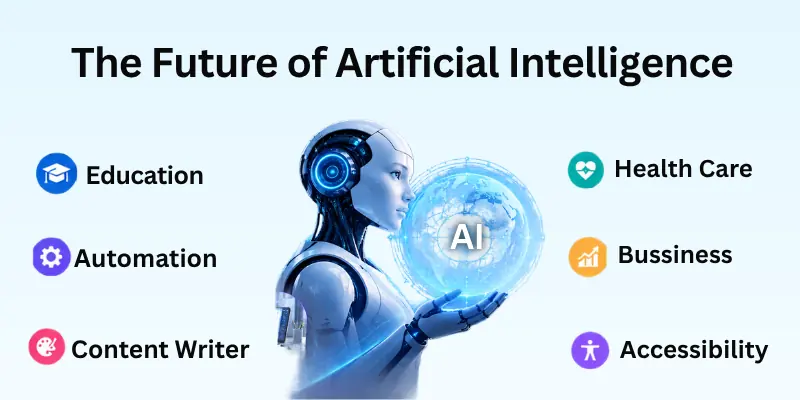
New AI tools may also create more learning and career opportunities. However, accuracy, privacy, and responsible use will remain important as this technology continues to grow.
AI in Education:
- AI may help students understand difficult topics through simple explanations and personalized learning.
- AI-powered learning tools may help teachers prepare lessons, quizzes, and learning materials.
AI in Healthcare:
- AI may help healthcare professionals analyze medical information and identify patterns.
- It may support medical research and help specialists study diseases, but important medical decisions will still require professional judgment.
AI in Business and Digital Marketing:
- Businesses may use AI to understand customer needs, analyze information, and improve their services.
- Digital marketers may use AI tools to generate ideas, research keywords, and plan content.
AI in Content Creation:
- Generative AI tools may become more integrated into writing, image creation, video production, and other creative tasks.
- Content creators may use these tools to save time, develop ideas, and improve their workflows.
AI and Automation:
- AI may automate more repetitive tasks, allowing people to focus on work that requires creativity and decision-making.
- However, changes in automation may also affect some jobs and increase the need for new skills.
AI in Everyday Applications:
- AI features may become more common in mobile apps, search engines, navigation systems, and productivity tools.
- These features may help people organize information, complete routine tasks, and find relevant suggestions more easily.
New Skills and Career Opportunities:
- As AI technology develops, skills such as data analysis, AI tool usage, critical thinking, and problem-solving may become increasingly useful.
- Learning how to work with AI tools can help beginners prepare for changing workplace requirements.
Challenges in the Future of AI:
- AI systems may still produce incorrect information, so checking important facts will remain necessary.
- Privacy, security, fairness, cost, and responsible use will continue to be important concerns.
- Human supervision will be valuable when AI is used for important decisions.
The Importance of Responsible AI:
- Developers and organizations need to consider how their AI systems affect people.
- Users should protect their personal information and understand the limitations of the tools they use.
- Governments and organizations may introduce or improve rules to encourage safer and more responsible AI development.
How Beginners Can Prepare for the Future :
- Start by learning the basic concepts of Artificial Intelligence.
- Explore AI tools and practice using them for simple, useful tasks.
- Check AI-generated information instead of accepting every answer as correct.
- Develop skills that complement AI, such as communication, creativity, and critical thinking.
- Keep learning as new tools and technologies become available.
Final Thought: The future of Artificial Intelligence will depend not only on technological progress but also on how people choose to develop and use it. AI may create new opportunities and make many tasks easier, but responsible use, human judgment, and continuous learning will remain important.
How Can Beginners Start Learning AI?
You do not need to become an expert programmer before learning the basic concepts of artificial intelligence. Beginners can start with simple explanations and practical activities.
Understand the Basic Terms: Start by learning the meaning of AI, machine learning, deep learning, AI models, algorithms, and generative AI.
Explore Everyday Examples: Look at AI features you already encounter, such as spam filters, recommendation systems, translation tools, and chatbots.
Try an AI Tool: Use a suitable AI tool for a simple task, such as explaining a concept, creating a study outline, or brainstorming ideas. Compare its response with reliable information to understand both its strengths and limitations.
Learn How to Write Clear Prompts: A prompt is an instruction or question given to an AI tool.
Unclear prompt: Explain AI.
Clearer prompt: Explain artificial intelligence in simple English for a beginner. Give three everyday examples and explain one limitation.
The second prompt gives the tool more information about what the user needs.
Study Basic Computer Science: If you want to explore AI more deeply, learning basic programming, mathematics, statistics, and data concepts can be helpful.
Python is commonly used in AI development, but you can begin learning the concepts without programming.
Practice and Verify: Try small learning projects, check the accuracy of AI-generated information, and record what you learn.
AI Best Practices for Beginners
Using AI responsibly is just as important as understanding how it works.
- Verify important information: Check factual claims using reliable sources.
- Protect your privacy: Avoid sharing passwords, private documents, or unnecessary personal information.
- Use clear prompts: Explain your goal, audience, context, and preferred format.
- Review generated content: Check facts, grammar, tone, and relevance before publishing or submitting work.
- Respect copyright: Make sure you have the appropriate rights to use any material you publish.
- Follow academic rules: Use AI in ways permitted by your school or educational institution.
- Keep human judgment involved: Do not rely blindly on AI for important decisions.
- Choose tools carefully: Consider cost, privacy, accuracy, and the features you actually need.
Conclusion
Artificial Intelligence is becoming an important part of our daily lives. It helps people complete tasks, find information, learn new skills, and create content. However, AI can also make mistakes, so we should not trust every answer without checking it.
In my opinion, learning about AI is a good step for anyone who wants to understand modern technology. You can start by exploring simple AI tools and learning how to use them correctly. However, you should always protect your privacy, check important information, and use your own knowledge and judgment.
My advice is to learn AI and use it as a helpful tool, not as a complete replacement for your own thinking. The more you understand its uses and limitations, the better you can decide when and how to use it.
Frequently Asked Questions (FAQs)
Now that we have explored some interesting facts about artificial intelligence, let’s answer a few common questions to help you understand AI even better.
Artificial Intelligence (AI) is a technology that enables computers to perform tasks that usually require human intelligence. These tasks include recognizing images, understanding language, and solving certain problems. Chatbots and translation tools are common examples of AI.
AI stands for Artificial Intelligence. “Artificial” means something created by humans, while “intelligence” refers to abilities such as learning and problem-solving. AI systems are designed to perform tasks associated with intelligent behavior.
Artificial Intelligence is a branch of computer science that develops systems capable of performing intelligent tasks. These tasks may include learning from data, recognizing patterns, processing language, and making predictions.
Common examples of AI include:
- Chatbots that answer questions.
- Voice assistants that respond to commands.
- Recommendation systems that suggest videos or products.
- Translation tools and AI image generators.
Many AI systems process data using algorithms and models. During training, some models learn patterns from examples. They use these patterns to generate responses, recognize information, or make predictions.
AI can analyze information and solve certain problems, but it does not necessarily think like humans. People have personal experiences and emotions, while AI processes information through computational methods. Human-like responses do not prove that AI has human consciousness.
Some AI systems learn patterns during training or adapt under specific conditions. However, many AI tools do not automatically learn from every interaction. Developers may need to update their models to improve performance.
Model training is the process of teaching an AI model to recognize patterns in data. For example, a model can learn from cat and dog images to classify new pictures. Training quality can affect how accurately the model performs.
AI is commonly classified into three capability-based categories:
- Narrow AI: Performs specific tasks.
- AGI: A hypothetical AI with broad, human-comparable intellectual abilities.
- ASI: A theoretical AI that would exceed human intellectual abilities across many areas.
AGI and ASI are not established existing technologies.
Yes, beginners can learn basic AI concepts without programming. They can explore chatbots, translation tools, and AI writing applications. Coding becomes useful when they want to develop their own AI systems.
Some AI tools offer free versions, while others require paid subscriptions for additional features. The available options and usage limits vary between tools. Beginners should compare features, costs, and privacy policies before choosing a tool.
AI can save time by assisting with repetitive tasks and processing information quickly. It can also support learning, content creation, data analysis, and automation. However, its benefits depend on the tool and how accurately it performs.
AI can produce incorrect information, reflect bias, and misunderstand context. Some tools also raise privacy, security, and cost concerns. Users should verify important information and avoid sharing sensitive personal data.
AI helps people process information, recognize patterns, and automate certain tasks. It is used in education, business, healthcare research, and digital marketing. When used responsibly, it can support problem-solving and innovation.
AI can help with tasks such as classifying emails, recognizing images, translating languages, and predicting patterns in data. It can also generate content and automate routine activities. However, it may struggle when information is incomplete or a problem requires complex human judgment.
AI is used in many digital services, including search engines, shopping platforms, social media, and email applications. It can recommend content, filter spam, and help estimate travel times. These features make certain everyday tasks easier.
AI may automate some tasks and change the skills needed for certain jobs. It can also help workers complete tasks more efficiently and create new opportunities. Learning digital skills, critical thinking, and responsible AI use can help people adapt to changes.
AI may become more widely used in education, healthcare, business, and content creation. Future developments could improve automation and information processing. However, accuracy, privacy, fairness, and responsible use will remain important challenges.
Beginners can start by learning basic AI terms and exploring simple AI tools. They should practice writing clear prompts and checking AI-generated answers. Programming and mathematics can be learned later for more advanced AI development.
Use AI carefully by checking important facts and protecting personal information. Review AI-generated content before publishing or submitting it, and respect copyright rules. Always use your own judgment instead of relying entirely on AI.


- Be Respectful
- Stay Relevant
- Stay Positive
- True Feedback
- Encourage Discussion
- Avoid Spamming
- No Fake News
- Don't Copy-Paste
- No Personal Attacks
- Be Respectful
- Stay Relevant
- Stay Positive
- True Feedback
- Encourage Discussion
- Avoid Spamming
- No Fake News
- Don't Copy-Paste
- No Personal Attacks
