History of Artificial Intelligence: From Early Ideas to Modern AI
Published: 2 Nov 2026
Have you ever wondered how Artificial Intelligence started and how it became part of our daily lives? The history of AI goes back several decades, when scientists began exploring whether computers could perform tasks that usually require human intelligence. Over time, new discoveries and improvements in computer technology helped AI develop into a powerful tool.
In this article, we will explore the history of Artificial Intelligence, its major milestones, important achievements, and how it has changed over the years.
The Early Ideas of Artificial Intelligence
The idea of creating intelligent machines existed before modern AI technology became available. Scientists wanted to understand whether machines could follow instructions, solve problems, and perform tasks that normally require human intelligence.
Some important developments that helped shape these early ideas include:
- The study of human intelligence: Researchers explored how people learn, reason, and solve problems.
- The development of computing: Early computers showed that machines could process information and follow complex instructions.
- The idea of intelligent machines: Scientists began considering whether computers could simulate certain aspects of human thinking.
These ideas helped establish the foundation for future Artificial Intelligence research.
Alan Turing and the Beginning of AI (1950)
Alan Turing was a British mathematician who made important contributions to computer science. In 1950, he published a paper titled Computing Machinery and Intelligence, which explored whether machines could demonstrate intelligent behavior.
His work introduced important ideas, including:
- Machine intelligence: Turing explored whether computers could perform tasks associated with intelligent behavior.
- The Turing Test: He proposed a test based on whether a machine could communicate in a way that made it difficult to distinguish its responses from a human’s.
- Influence on AI research: His ideas helped researchers think more deeply about machine intelligence and how it could be evaluated.
Turing’s work became an important milestone in the history of Artificial Intelligence.
The Birth of Artificial Intelligence (1956)
The year 1956 is widely considered a major turning point in AI history. A research workshop at Dartmouth College helped establish Artificial Intelligence as a formal field of study. Computer scientist John McCarthy played a leading role in organizing the workshop and introducing the term “Artificial Intelligence.”
Important developments included:
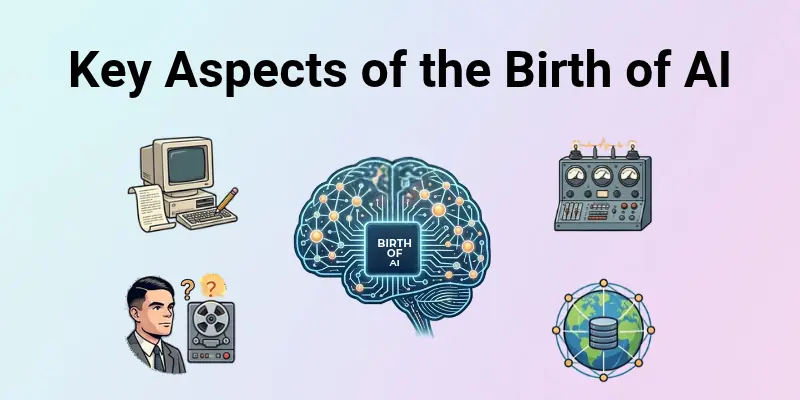
- The Dartmouth workshop: Researchers gathered to explore whether aspects of learning and intelligence could be simulated by machines.
- John McCarthy’s contribution: He helped establish the name Artificial Intelligence for this research field.
- Early AI programs: Researchers began creating programs that could solve logical problems and perform simple reasoning tasks.
This event encouraged further research into intelligent computer systems.
Early AI Programs and Experiments
After AI became a recognized research field, scientists began developing programs that could perform specific tasks. These early systems were limited compared with modern AI, but they demonstrated that computers could solve certain problems using logical rules.
Some important examples were:
- Logic Theorist: An early AI program developed by Allen Newell, Herbert Simon, and Cliff Shaw that could prove certain mathematical theorems.
- Checkers-playing programs: Researchers explored how computers could play games and improve their performance through experience.
- ELIZA: Developed by Joseph Weizenbaum in the 1960s, this early conversational program simulated a text-based conversation.
These experiments helped researchers explore problem-solving, learning, and communication through computers.
Challenges and AI Winters
AI research did not progress smoothly. During some periods, researchers struggled to achieve the results they had expected. Limited computing power, insufficient data, and overly ambitious predictions contributed to reduced funding and interest.
These periods became known as AI winters.
Key points include:
- Limited technology: Early computers could not handle many complex tasks efficiently.
- Unmet expectations: Some AI systems could not perform as well as researchers had hoped.
- Reduced funding: Disappointing results led some organizations to reduce their investment in AI research.
- Continued research: Despite these difficulties, scientists continued working on new approaches and improving computer systems.
These setbacks showed that developing useful AI required time, better technology, and realistic expectations.
The Rise of Expert Systems
During the 1970s and 1980s, expert systems became an important area of AI research. These systems used rules and stored knowledge to help solve problems in specific fields.
Their main features included:
- Rule-based decisions: They followed predefined rules to reach conclusions.
- Specialized knowledge: They were designed for particular areas, such as medicine or engineering.
- Decision support: They could help users analyze information and consider possible solutions.
- Important limitations: Their performance depended on the quality of their rules and stored knowledge.
Expert systems demonstrated that AI could support practical tasks, although they were not able to handle every situation.
IBM Deep Blue’s Achievement (1997)
One of the most famous moments in AI history occurred in 1997, when IBM’s Deep Blue computer defeated world chess champion Garry Kasparov in a six-game match.
This achievement was important for several reasons:
- Advanced chess computing: Deep Blue could evaluate many possible chess moves.
- Strategic problem-solving: The match demonstrated the strength of specialized computer systems in complex games.
- Public attention: The result attracted worldwide interest in what computers could achieve.
- A specific capability: Deep Blue’s success in chess did not mean it had general human intelligence.
This event became a major milestone in the development and public understanding of AI.
The Growth of Machine Learning
As computers became more powerful and more data became available, researchers increasingly explored machine learning. Instead of relying only on manually written rules, machine learning systems can learn patterns from examples.
Important developments included:
- Learning from data: Models identify patterns in training examples.
- Improved predictions: Trained systems can use learned patterns to make predictions or classify information.
- More applications: Machine learning became useful in areas such as spam detection, recommendations, and speech recognition.
- Ongoing improvement: Researchers continued developing methods to make models more accurate and useful.
Machine learning became one of the most important approaches within modern Artificial Intelligence.
The Development of Deep Learning
Deep learning is a type of machine learning that uses neural networks with multiple layers to learn complex patterns. Improvements in computing power, training methods, and access to data helped deep learning become more effective.
Some of its important applications include:
- Image recognition: Identifying objects and patterns in images.
- Speech recognition: Converting spoken words into text.
- Language processing: Helping computers process and generate human language.
- Complex data analysis: Learning patterns from large and complicated datasets.
Deep learning contributed to many of the AI capabilities that people use today.
Modern AI and Generative AI
Modern AI has developed rapidly, especially in systems that can understand and generate language, images, audio, and other types of content. These tools are becoming more accessible to individuals, students, and businesses.
Examples of modern AI applications include:
- AI chatbots: Answer questions and help explain topics.
- AI writing tools: Assist with outlines, drafts, and editing.
- Image generators: Create visuals from written descriptions.
- AI assistants: Help users organize information and complete certain tasks.
- Business applications: Support data analysis, customer service, and routine workflows.
Although modern AI tools can be useful, their responses may contain errors, so important information should always be checked.
How AI Has Changed Over Time
Artificial Intelligence has changed significantly since its early development. Early systems mainly followed predefined rules and solved limited problems, while modern systems can learn patterns from data and perform a wider range of tasks.
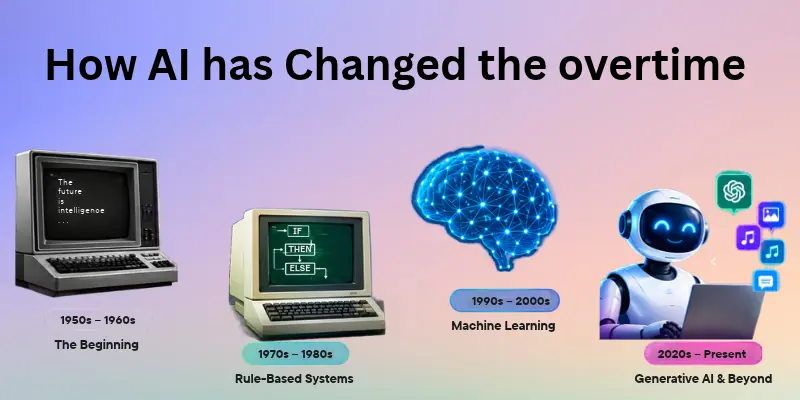
Here are some key changes:
- From rules to learning: Many AI systems now learn patterns from examples instead of relying only on manually written rules.
- From simple tasks to complex outputs: Modern AI can process language, recognize images, and generate content.
- From research labs to everyday tools: AI is now available through many applications used for learning, communication, and work.
- From limited data to large datasets: Improvements in data availability and computing have supported more capable models.
- Continued challenges: Accuracy, privacy, fairness, and responsible use remain important concerns.
The history of AI shows that progress has involved both major achievements and important challenges.
Interesting Facts About Artificial Intelligence History
Here are some interesting facts that highlight important moments in the development of AI:
- 1950: Alan Turing published his influential paper about machine intelligence.
- 1956: The Dartmouth workshop helped establish AI as a formal research field.
- 1960s: ELIZA demonstrated an early form of computer-based conversation.
- 1997: IBM Deep Blue defeated world chess champion Garry Kasparov.
- Machine learning: This approach allows models to learn patterns from data.
- Deep learning: Neural networks with multiple layers have helped advance image, speech, and language processing.
- Generative AI: Modern systems can create text, images, and other content based on patterns learned during training.
These milestones show how Artificial Intelligence has developed through research, experimentation, and advances in technology.
Conclusion
The history of Artificial Intelligence shows how an idea about intelligent machines developed into an important field of technology. From Alan Turing’s early ideas to machine learning, deep learning, and modern generative AI, each stage has introduced new possibilities.
In my opinion, learning about AI history helps us understand both the achievements and limitations of this technology. Beginners can start by exploring basic AI tools and learning how they work. However, it is important to check AI-generated information and use these tools responsibly. AI will continue to develop, and understanding its history can help us make better use of its future possibilities.
Frequently Asked Questions (FAQs) About the History of Artificial Intelligence
The history of Artificial Intelligence includes many important discoveries, achievements, and challenges. To help you understand how AI developed over time, we have answered some common questions about its history, major milestones, and technological progress. These FAQs will give beginners a quick and clear overview of AI’s journey from early ideas to modern AI tools.
Artificial Intelligence became a formal field of study in 1956 during a research workshop at Dartmouth College. However, the ideas behind intelligent machines existed before that time.
John McCarthy is often called the father of Artificial Intelligence because he helped establish AI as a research field and introduced the term “Artificial Intelligence” in 1956.
One of the earliest ideas was to find out whether machines could perform tasks that normally require human intelligence, such as reasoning, learning, and problem-solving.
Alan Turing published a paper called Computing Machinery and Intelligence in 1950. He explored machine intelligence and proposed what became known as the Turing Test.
In 1956, researchers gathered at the Dartmouth workshop to explore how machines could simulate aspects of human intelligence. This event helped establish AI as a formal research field.
ELIZA was an early computer program developed by Joseph Weizenbaum in the 1960s. It simulated a text-based conversation and demonstrated an early approach to human-computer interaction.
AI winters were periods when interest and funding for AI research decreased. These periods occurred partly because early systems did not meet high expectations and available technology had limitations.
Expert systems were AI programs that used stored knowledge and predefined rules to solve problems in specific fields. They became an important area of AI research during the 1970s and 1980s.
In 1997, IBM’s Deep Blue defeated world chess champion Garry Kasparov in a six-game match. This achievement showed how powerful specialized computer systems could be at complex games.
Machine learning allowed computers to identify patterns from data instead of depending only on manually written rules. It helped expand AI applications in prediction, recommendations, and speech recognition
Deep learning is a type of machine learning that uses neural networks with multiple layers. It has helped improve image recognition, speech processing, and language-related tasks.
AI has developed from early programs that followed specific rules into more advanced systems that can learn patterns, process language, recognize images, and generate content.
Generative AI is a type of AI that can create new content, such as text, images, audio, and other outputs, based on patterns learned during training.
AI developed over many decades, but improvements in computing, data, and online tools made it increasingly accessible. Modern AI assistants and content-generation tools have helped bring AI to a wider audience.
Some major milestones include Alan Turing’s 1950 paper, the Dartmouth workshop in 1956, the development of ELIZA in the 1960s, Deep Blue’s chess victory in 1997, and advances in machine learning, deep learning, and generative AI.
Early AI systems usually followed predefined rules and handled limited tasks. Modern AI systems can learn patterns from large datasets and perform a wider range of tasks, although they can still make mistakes.
AI can help people analyze information, recognize patterns, automate repetitive tasks, support learning, and create content. Its usefulness depends on the task and the quality of the system.
AI has faced limited computing power, insufficient data, funding reductions, and difficulties meeting expectations. Today, concerns also include accuracy, privacy, fairness, and responsible use.
AI is likely to continue developing in areas such as education, healthcare, business, and content creation. Its future will depend on technological progress, human decisions, and responsible development.
Learning about AI history helps us understand how this technology developed, what researchers have achieved, and what challenges remain. It also helps beginners use modern AI tools with better awareness and responsibility.





- Be Respectful
- Stay Relevant
- Stay Positive
- True Feedback
- Encourage Discussion
- Avoid Spamming
- No Fake News
- Don't Copy-Paste
- No Personal Attacks
- Be Respectful
- Stay Relevant
- Stay Positive
- True Feedback
- Encourage Discussion
- Avoid Spamming
- No Fake News
- Don't Copy-Paste
- No Personal Attacks
