Future of Artificial Intelligence:
Published: 3 Nov 2026
Artificial Intelligence (AI) is changing the way people live, work, learn, and communicate. From smart assistants and self-driving cars to medical technology and business automation, AI is becoming an important part of everyday life. What once seemed like science fiction is now a reality.
The future of artificial intelligence is expected to bring even more advanced technologies, smarter machines, and new ways to solve complex problems. Businesses may use AI to improve productivity, doctors may use it to support medical decisions, and students may benefit from more personalized learning experiences.
However, AI also raises important questions about privacy, job opportunities, security, and human control. Understanding these developments can help individuals and businesses prepare for the changes ahead.
In this article, I will explore the future of artificial intelligence, its expected trends, major applications, potential benefits, challenges, and the factors that may shape its development.
20 Major Trends Shaping the Future of Artificial Intelligence
Artificial intelligence is developing rapidly, and several important trends are expected to shape its future. These developments will influence how people work, communicate, learn, and solve problems.
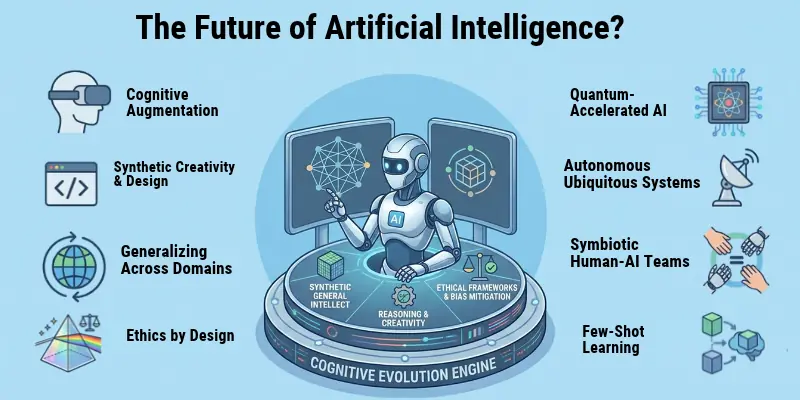
Understanding these trends can help individuals and businesses prepare for upcoming technological changes.
Advanced Machine Learning
Machine learning will continue to improve how computers learn from data and recognize patterns. Future systems may become better at analyzing complex information, identifying relationships, and making predictions. These improvements could help businesses, researchers, and organizations solve problems more efficiently.
Advanced machine learning may also reduce the need for manual data analysis by identifying useful insights automatically. As algorithms improve, AI systems could become more adaptable to changing situations and different types of information.
– Better data analysis
– More accurate predictions
– Automated pattern recognition
– Improved problem-solving
Generative AI Growth
Generative AI is expected to become more advanced in producing written content, images, videos, music, and digital designs. These technologies may help creators, marketers, educators, and businesses produce content more efficiently. Future tools could also provide greater creative control and generate more realistic digital experiences.
As generative AI develops, people may use it for personalized advertisements, educational materials, product designs, and entertainment. However, copyright protection, misinformation, and content authenticity will remain important concerns.
– AI-generated videos
– Automated content creation
– Digital image generation
– Personalized creative tools
Autonomous Vehicles
Autonomous vehicles use artificial intelligence, sensors, cameras, and advanced computer systems to understand their surroundings and make driving-related decisions. Future developments may improve their ability to recognize obstacles, understand road conditions, and respond to unexpected situations.
Self-driving technology could influence public transportation, delivery services, logistics, and personal travel. However, safety testing, infrastructure, legal requirements, and public acceptance will determine how widely autonomous vehicles are adopted.
– Self-driving technology
– Intelligent traffic monitoring
– Automated delivery vehicles
– Advanced road safety systems
AI in Healthcare
Artificial intelligence may play an increasingly important role in healthcare by helping medical professionals analyze medical images, identify patterns, and organize patient information. AI-powered systems could support the early identification of certain health conditions and assist researchers in studying potential treatments.
Future healthcare applications may also improve hospital management, medical research, and personalized treatment planning. However, medical professionals will need to verify AI recommendations and maintain responsibility for important clinical decisions.
– AI-assisted medical diagnosis
– Personalized treatment planning
– Medical image analysis
– Healthcare data management
Personalized Education
AI may transform education by providing learning experiences based on individual student needs, interests, and academic progress. Intelligent learning platforms could identify areas where students struggle and recommend suitable lessons, exercises, and explanations.
Teachers may also use AI to prepare educational materials, evaluate learning progress, and reduce repetitive administrative tasks. This could make education more flexible while allowing teachers to focus on student development and personal guidance.
– Personalized learning plans
– AI-powered virtual tutors
– Automated learning assessments
– Individual progress tracking
Smart Robotics
Smart robotics combines artificial intelligence with machines that can perform physical tasks in different environments. Future robots may become more capable of recognizing objects, understanding instructions, and adjusting their movements according to changing conditions.
These technologies could support manufacturing, healthcare, agriculture, warehouses, and household activities. Robots may also work alongside humans to perform repetitive or physically demanding tasks more efficiently.
– Intelligent industrial robots
– Automated warehouse operations
– Healthcare assistance robots
– Smart household machines
AI-Powered Automation
AI-powered automation allows computer systems to complete repetitive and time-consuming activities with less manual involvement. Businesses may increasingly use AI to manage customer inquiries, organize documents, process information, and perform routine administrative work.
Future automation systems could also connect multiple business processes, allowing organizations to manage complicated workflows more efficiently. Human supervision will remain important for handling unusual situations and checking important decisions.
– Automated business operations
– Faster document processing
– Intelligent customer support
– Improved workflow management
Natural Language Processing
Natural Language Processing (NLP) helps computers understand, interpret, and generate human language. Future NLP systems may become better at understanding context, different languages, complex questions, and natural conversations.
This development could improve translation services, virtual assistants, customer support, and communication tools. People may be able to interact with computers more naturally without needing complicated commands or technical knowledge.
– Real-time language translation
– Natural AI conversations
– Intelligent voice assistants
– Automated text analysis
Cybersecurity Improvements
AI may become an important tool for protecting digital systems against cyber threats. Intelligent security platforms can analyze network activities, identify unusual behavior, and help security professionals detect potential attacks.
Future cybersecurity solutions may respond to certain threats more quickly by monitoring systems continuously and identifying suspicious patterns. At the same time, attackers may also use AI to develop more advanced scams, making strong security practices essential.
– Real-time threat detection
– Automated security monitoring
– Suspicious activity identification
– Faster incident response
Smart Cities
Smart cities may use artificial intelligence to manage urban infrastructure, transportation, electricity, and public services. AI-powered systems could analyze information from sensors and connected devices to understand traffic conditions and improve resource management.
These technologies may help cities reduce congestion, monitor energy consumption, and improve public transportation planning. Successful implementation will require reliable infrastructure, strong data protection, and effective public policies.
– Intelligent traffic management
– Smart energy distribution
– Connected public services
– Urban infrastructure monitoring
Predictive Analytics
Predictive analytics uses historical data, statistical methods, and machine learning to identify patterns and estimate possible future outcomes. Businesses may use these systems to understand customer behavior, forecast demand, and identify potential operational problems.
As AI models improve, predictive analytics could become more useful in finance, healthcare, retail, manufacturing, and supply chain management. Predictions will still depend on the quality of available data and should not be treated as guaranteed outcomes.
– Future demand forecasting
– Customer behavior prediction
– Business risk identification
– Data-driven planning
AI in Agriculture
Artificial intelligence may help farmers improve agricultural practices by analyzing information about soil conditions, weather, crops, and water usage. Smart farming technologies could identify plant diseases, monitor crop growth, and support better resource management.
Future AI applications may also help farmers make more informed decisions about irrigation, fertilization, and harvesting. These developments could support agricultural productivity, particularly when combined with suitable equipment and reliable data.
– Smart crop monitoring
– Plant disease identification
– Intelligent irrigation systems
– Agricultural data analysis
Advanced Virtual Assistants
Virtual assistants are becoming more capable of understanding voice commands, answering questions, and helping users complete everyday activities. Future assistants may handle more complicated requests, understand conversation history, and connect with different digital services.
These systems could help people manage schedules, organize information, prepare reminders, and perform routine tasks. Their usefulness will depend on accuracy, privacy protection, and the level of access users provide.
– Smart daily scheduling
– Voice-based communication
– Automated task management
– Personalized digital assistance
AI in Scientific Research
Artificial intelligence may support scientific research by helping researchers analyze large datasets, recognize patterns, and explore complex scientific problems. It could assist in areas such as medicine, chemistry, environmental science, and material development.
Future AI research tools may help scientists test ideas, examine research information, and identify promising areas for further investigation. Human expertise and scientific validation will remain necessary to confirm research findings.
– Faster data analysis
– Scientific pattern recognition
– Drug discovery assistance
– Advanced research simulations
Human-AI Collaboration
Human-AI collaboration refers to people and intelligent systems working together to complete tasks and solve problems. Instead of replacing every human activity, AI may support professionals by providing information, generating suggestions, and automating repetitive work.
This collaboration could improve productivity in creative industries, education, engineering, healthcare, and business management. Human creativity, communication, judgment, and accountability will continue to play important roles.
– Improved workplace productivity
– AI-assisted decision-making
– Human creativity support
– Collaborative problem-solving
Financial Technology
Artificial intelligence may continue transforming financial services by helping banks and financial institutions analyze transactions, identify suspicious activities, and assess potential risks. AI-powered systems could also improve customer service and automate certain financial operations.
In the future, financial platforms may offer more personalized services based on customer needs and financial information. However, financial institutions must carefully manage privacy, security, fairness, and regulatory requirements.
– Automated fraud detection
– Financial risk analysis
– Personalized banking services
– Intelligent transaction monitoring
AI-Powered Manufacturing
Manufacturing industries may use artificial intelligence to improve production processes, monitor equipment, and identify quality problems. AI-powered systems can analyze machine performance and help manufacturers detect possible equipment failures before they cause major disruptions.
Future smart factories may combine AI, robotics, sensors, and connected systems to coordinate different production activities. This could help organizations reduce waste, improve product quality, and manage operations more effectively.
– Intelligent quality control
– Predictive equipment maintenance
– Automated production monitoring
– Reduced manufacturing waste
Multimodal AI
Multimodal AI refers to artificial intelligence systems that can process and understand different types of information, including text, images, audio, and video. This technology allows users to interact with AI through multiple formats instead of relying only on written instructions.
Future multimodal systems may help users analyze videos, understand spoken questions, describe images, and combine different information sources. These capabilities could improve education, entertainment, research, and professional communication.
– Text and image understanding
– Audio recognition
– Video content analysis
– Multiple-input AI interaction
AI Safety and Regulation
As artificial intelligence becomes more widely used, safety and regulation will become increasingly important. Governments, researchers, and technology companies will need to address concerns involving data privacy, unfair decisions, misinformation, cybersecurity, and responsible AI development.
Future AI regulations may focus on transparency, accountability, risk management, and human oversight. Clear guidelines could help organizations use AI responsibly while protecting individuals and society from potential harm.
– Responsible AI development
– Data privacy protection
– Transparent AI systems
– Stronger safety guidelines
More Accessible AI Tools
AI tools may become easier to access and use for individuals, students, small businesses, and organizations. User-friendly platforms could allow people to perform tasks such as writing, designing, analyzing information, and organizing work without advanced technical knowledge.
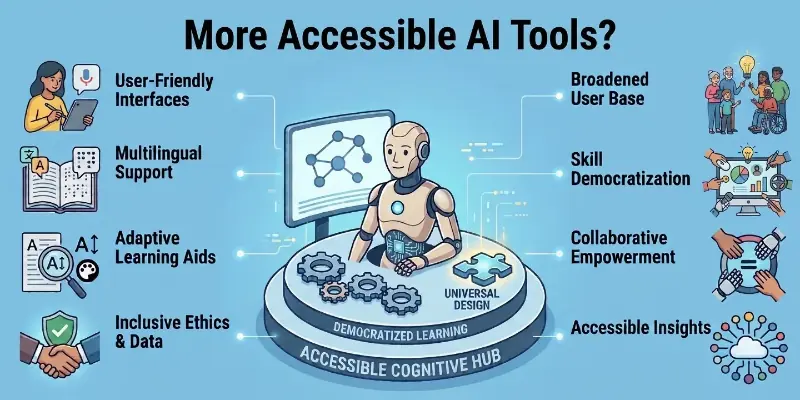
Greater accessibility may also help small organizations benefit from technologies that were previously expensive or difficult to implement. However, affordability, internet access, digital literacy, and data protection will influence how widely these tools are adopted.
Easy-to-use AI platforms
Affordable AI applications
No-code AI solutions
Wider technology accessibility
Common Uses of Artificial Intelligence in the Future
Artificial intelligence may become useful in almost every major industry. Some important applications include:
Healthcare and Medicine:AI may support doctors in analyzing medical images, organizing patient information, identifying patterns, and researching potential treatments. It can also help researchers study complex medical data.
Education and Learning: Educational institutions may use AI tutors, automated assessments, and personalized learning platforms. These tools could help students understand difficult subjects and learn at their own pace.
Business and Marketing: Companies may use AI to analyze customer behavior, automate marketing activities, improve customer service, and identify business opportunities.
Transportation and Logistics: AI may improve route planning, traffic prediction, vehicle monitoring, and warehouse operations. Autonomous transportation systems may also develop further.
Banking and Finance: Banks may use AI to monitor suspicious transactions, assess financial risks, improve customer support, and analyze market information.
Agriculture and Farming: AI-powered technologies may help farmers monitor soil conditions, identify crop problems, manage irrigation, and improve agricultural productivity.
Entertainment and Media: AI may support video editing, animation, content recommendations, music production, and digital storytelling.
Benefits of Artificial Intelligence in the Future
The future development of AI may create several opportunities for individuals, organizations, and society.
Higher Productivity:AI can help complete repetitive tasks faster and support more efficient workflows.
Better Decision-Making: Advanced data analysis may help people make informed decisions.
Improved Healthcare: AI may support medical research and assist healthcare professionals.
Personalized Services: Businesses and educational platforms may provide experiences based on individual needs.
Scientific Progress: AI can help researchers analyze complex information and explore new possibilities.
Greater Accessibility: AI-powered tools may make certain digital services easier to access.
Time Savings: Automation can reduce the time required for routine activities.
These benefits will depend on how AI systems are designed, tested, and used.
Challenges and Risks of Future Artificial Intelligence
Although AI offers many opportunities, its development also creates challenges that need attention.
Job Displacement: Automation may reduce demand for some repetitive tasks and change certain job roles.
Data Privacy: AI systems may process large amounts of personal and business information.
Cybersecurity Threats: Criminals may misuse AI to create more convincing scams and cyberattacks.
Bias and Discrimination: Poor-quality or unbalanced training data may produce unfair results.
Incorrect Information: AI systems can generate inaccurate answers that appear convincing.
Lack of Transparency: Some advanced AI systems are difficult to understand or explain.
Overdependence on Technology: Excessive reliance on AI may reduce independent thinking in certain situations.
Regulation Difficulties: Governments may struggle to create rules that keep pace with technological progress.
Responsible development, human oversight, and proper security measures will be important for managing these risks.
Factors to Consider When Preparing for the Future of AI
Understanding future AI developments is useful, but individuals and businesses should also consider several important factors.
Technical Skills: Learning basic AI concepts, data analysis, and digital skills can help people understand new technologies.
Data Privacy: Organizations should protect sensitive information and understand how AI tools collect and process data.
Human Oversight: Important decisions should include appropriate human review, especially in healthcare, finance, education, and other sensitive areas.
Cost and Accessibility: Businesses should evaluate the cost of AI tools, infrastructure, maintenance, and employee training before adopting them.
Accuracy and Reliability: AI-generated information should be checked before it is used for important decisions.
Ethical Responsibilities: Developers and organizations should consider fairness, transparency, accountability, and the possible effects of AI on society.
Common Mistakes People Make About the Future of Artificial Intelligence
Many people misunderstand what future AI development may actually mean. Avoiding these mistakes can help create more realistic expectations.
Believing AI Will Replace Everyone: AI may change many professions, but that does not mean every job will disappear. Many roles require human judgment, communication, creativity, and responsibility.
Trusting Every AI Result: AI-generated information is not always accurate. Important facts should be verified through reliable sources.
Ignoring Privacy: Using AI tools without understanding their data policies can create unnecessary privacy risks.
Avoiding New Skills:People who ignore technological developments may find it harder to adapt to changing workplace requirements.
Expecting Instant Results: AI adoption requires planning, testing, investment, and training. It does not automatically solve every problem.
Ignoring Human Judgment: AI should support human decisions rather than replace careful thinking in situations where experience and responsibility matter.
How to Prepare for the Future of Artificial Intelligence
Preparing for future AI developments does not require becoming a professional programmer. Individuals and businesses can take practical steps to understand and use this technology.
Learn AI Basics: Understand machine learning, generative AI, automation, and common AI applications.
Develop Digital Skills: Improve your knowledge of computers, online tools, data, and digital communication.
Practice Using AI Tools: Explore AI applications for research, writing, planning, and productivity.
Improve Critical Thinking: Learn to evaluate AI-generated answers instead of accepting everything automatically.
Protect Personal Data: Use trusted platforms and avoid sharing sensitive information unnecessarily.
Keep Learning: Follow reliable technology news, research reports, and educational resources.
Combine Human and AI Skills: Use AI to support your work while developing creativity, communication, and problem-solving abilities.
Businesses should also establish clear AI policies, train employees, evaluate risks, and monitor the performance of AI-powered systems.
Traditional Technology vs Future Artificial Intelligence
| Area | Traditional Technology | Future AI-Powered Technology |
|---|---|---|
| Data Analysis | Manual or rule-based | More advanced pattern analysis |
| Customer Support | Basic automated responses | More contextual assistance |
| Education | Standard learning materials | Personalized learning support |
| Healthcare | Traditional diagnostic support | AI-assisted analysis |
| Manufacturing | Fixed automation | More adaptive automation |
| Transportation | Human-controlled systems | Advanced driving assistance |
| Business | Manual reporting | Automated data insights |
| Research | Conventional data processing | AI-assisted research |
These are broad comparisons. Future capabilities will depend on the technology, industry, and level of human supervision.
Quick Summary Table
| Topic | Key Information |
|---|---|
| Main Keyword | Future of Artificial Intelligence |
| Technology | Machine Learning and Generative AI |
| Major Industries | Healthcare, Education, Finance, Business |
| Expected Developments | Robotics, Automation, Smart Systems |
| Main Opportunities | Productivity and Innovation |
| Major Challenges | Privacy, Security, Bias |
| Important Skills | Digital Literacy and Critical Thinking |
| Future Approach | Responsible Human-AI Collaboration |
Final Thoughts
The future of artificial intelligence will bring important changes to technology, businesses, education, healthcare, and everyday life. More advanced AI systems may help people complete tasks, analyze information, improve services, and solve complex problems.
At the same time, challenges such as job displacement, privacy, cybersecurity, and responsible decision-making cannot be ignored.
I believe the most important approach is to understand AI, learn how to use it effectively, and maintain human judgment. People who continue developing their skills and adapting to technological changes will be better prepared for an AI-driven world.
Artificial intelligence is not simply about creating smarter machines. It is also about finding better ways for humans and technology to work together.
Frequently Asked Questions (FAQs)
Before exploring the future of Artificial Intelligence, you may have some questions about its upcoming developments, possible benefits, challenges, and impact on everyday life. Here are answers to some frequently asked questions about the future of AI.
What is the future of artificial intelligence?
The future of artificial intelligence involves more advanced computer systems that can learn, analyze information, automate tasks, and support human decision-making across different industries.
Will artificial intelligence replace human jobs?
AI may automate certain tasks and change many job roles. However, it may also create new opportunities in technology, research, data management, and other fields. The overall impact will vary by industry and occupation.
Which industries will benefit most from future AI?
Healthcare, education, finance, manufacturing, agriculture, transportation, and entertainment are among the industries that may benefit from further AI development.
How will AI change education?
AI may support personalized learning, virtual tutoring, automated assessments, and educational content creation. Teachers will continue to play an important role in guidance and student development.
Can artificial intelligence become smarter than humans?
AI systems already perform better than humans on certain specialized benchmarks, while they remain limited in other areas. Whether future AI will exceed human abilities across a broad range of tasks remains uncertain.
What are the biggest risks of future AI?
Some major risks include privacy violations, biased decisions, cybersecurity threats, inaccurate information, job displacement, and insufficient human oversight.
How can students prepare for an AI-driven future?
Students can learn digital skills, understand AI tools, develop problem-solving abilities, improve communication, and practice critical thinking.
Will AI become part of everyday life?
AI is already part of many everyday services, including search engines, recommendation systems, digital assistants, and online customer support. Its use may become more widespread as technology develops.
What is the role of AI in future businesses?
AI may help businesses automate routine work, analyze customer information, improve marketing, support customer service, and make data-informed decisions.
Is artificial intelligence good or bad for society?
AI can provide useful opportunities, but it also creates risks. Its impact will depend on responsible development, proper regulation, transparency, and how people choose to use it.


- Be Respectful
- Stay Relevant
- Stay Positive
- True Feedback
- Encourage Discussion
- Avoid Spamming
- No Fake News
- Don't Copy-Paste
- No Personal Attacks
- Be Respectful
- Stay Relevant
- Stay Positive
- True Feedback
- Encourage Discussion
- Avoid Spamming
- No Fake News
- Don't Copy-Paste
- No Personal Attacks
